
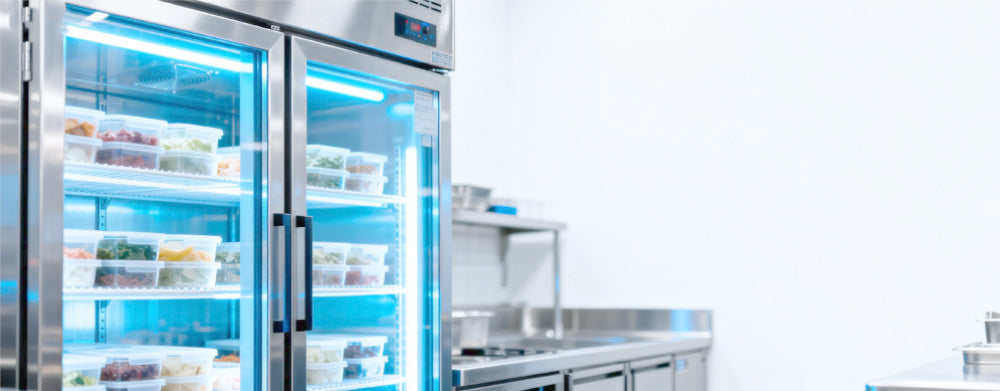
A commercial refrigerator isn’t “just cold storage.” It’s one of the most important tools for protecting ingredient quality, reducing food loss, and keeping daily operations smooth—especially during rush hours when doors open constantly.
The good news: most temperature problems come from a handful of predictable issues, and you can prevent them with a simple routine and the right equipment features.
1) What temperature should a commercial refrigerator be?
For food safety, the FDA recommends keeping refrigerators at 40°F (4°C) or below, and freezers at 0°F (-18°C). U.S. Food and Drug Administration
(Always follow your local health code and your operation’s HACCP plan if it requires a stricter standard.)
Pro tip: Don’t rely on a dial setting alone. Use a thermometer to confirm the actual cabinet temperature, and check it regularly. U.S. Food and Drug Administration
2) Where temperature problems usually start (and how to spot them fast)
Even good units can drift if workflow or upkeep slips. Watch for these common causes:
-
Overpacking blocks airflow. Cold air must circulate to keep everything evenly chilled. U.S. Food and Drug Administration
-
Frequent door opening during peak hours + slow recovery.
-
Hot product loads (large pans of warm food) pulling cabinet temps upward.
-
Dirty condenser coils causing longer run times and weaker cooling.
-
Worn door gaskets leaking cold air.
If you ever see inconsistent temps across shelves (top warm / bottom cold), it’s usually airflow + loading habits—before it’s “the unit is broken.”
3) A simple temperature-check routine (daily, weekly, monthly)
You don’t need complex logs to be effective. Start with this:
Daily (2 minutes)
-
Verify the display temp and confirm with a thermometer reading.
-
Check doors close fully (no “bounce-back”).
-
Make sure product isn’t pressed against interior vents.
Weekly (10 minutes)
-
Wipe spills immediately (helps sanitation and prevents odor buildup). U.S. Food and Drug Administration
-
Quick gasket check: look for cracks, gaps, or sticky spots.
-
Re-organize: keep higher-turn items at eye level to shorten door-open time.
Monthly (20–30 minutes)
-
Clean condenser area / filters (if applicable).
-
Inspect hinges and door alignment.
-
Review your setpoint: if you’re holding right at the limit, consider a slightly colder setpoint for “real-world” openings (without freezing produce).
4) Equipment features that make temperature stability easier
When you’re shopping for a new unit—or evaluating what’s “missing” from your current one—these features help most in real kitchens:
A) Precise digital temperature control
For example, Orikool reach-in models highlight a CAREL digital thermostat and a typical working range like 33–40°F, designed for consistent control in busy use. Orikool
B) Fan / ventilated cooling for even cabinet temps
Merchandising units on Orikool also describe dynamic fan cooling to help cool evenly and reduce frost/temperature swings during frequent openings. Orikool
C) Certifications & compliance signals
On Orikool product pages you’ll see listings such as ETL Listed / ETL Sanitation and DOE compliant (helpful for buyers who want clearer compliance expectations). Orikool+1
D) Warranty that matches commercial reality
Orikool states coverage like 5-year compressor / 2-year parts (accessories) across its messaging and product info—important for 24/7 equipment planning. Orikool+1
E) Lower-impact refrigerant options (where applicable)
Some Orikool models specify R290 refrigerant, and R290 is widely discussed in research as a low-GWP refrigerant option in the broader HVAC&R shift toward lower climate impact. Orikool+1
5) Quick operational habits that protect food (and your margins)
-
Avoid “open door browsing.” Pre-stage ingredients when possible.
-
Use smaller pans/containers for faster chilling instead of loading one giant hot container.
-
Train one simple rule: “Don’t block vents; don’t overpack; shut doors fully.”
-
Keep a spare thermometer in the warmest zone of the cabinet and check it at the same times every day. U.S. Food and Drug Administration
Conclusion
Stable refrigeration temperatures come down to three things: clear targets, simple checks, and equipment built for real commercial workflow.
At Orikool, our focus is smart refrigeration that supports both performance and sustainability—aligned with our brand idea: “Sustainably Yours, Orikool Cares.” Orikool
If you’re upgrading this year, start by matching the unit type (reach-in, undercounter, prep table, merchandiser) to your workflow, then prioritize temperature stability features and compliance signals.