
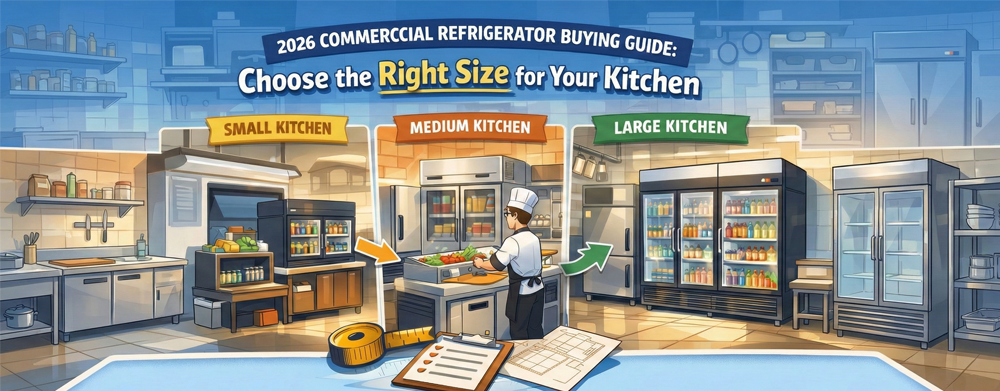
2026 Commercial Refrigerator Buying Guide: How to Choose the Right Unit by Kitchen Size
Buying a commercial refrigerator isn’t just about “How many cubic feet?” It’s about matching the equipment to your kitchen’s footprint and workflow—so you don’t end up with a unit that blocks a prep line, struggles to recover during rush, or wastes energy.
This guide breaks it down by small / medium / large kitchen layouts, with a simple checklist you can use before you buy.
Quick cheat sheet: kitchen size → best refrigeration setup
Small kitchens (food trucks, coffee shops, tight back-of-house)
Best fits:
-
1-door or compact reach-in refrigerator
-
A back bar cooler for beverages
-
A prep-friendly setup that keeps ingredients within arm’s reach
Start here:
-
Shop Commercial Reach-In Refrigerators: Orikool Reach-In Refrigerators
-
Shop Back Bar Coolers: Orikool Back Bar Coolers
Medium kitchens (most restaurants, delis, pizzerias)
Best fits:
-
2-door reach-in fridge for bulk storage
-
One prep table refrigerator for the line (pizza or sandwich/salad)
-
Separate freezer capacity if you’re holding frozen items regularly
Start here:
-
Shop Pizza Prep Table Refrigerators: Orikool Pizza Prep Refrigerators
-
Shop Sandwich & Salad Prep Refrigerators: Orikool Sandwich/Salad Prep
-
Shop Commercial Reach-In Freezers: Orikool Reach-In Freezers
Large kitchens (high-volume, multi-station, front-of-house merchandising)
Best fits:
-
Multiple zones (separate stations + backup storage)
-
Large reach-ins (including 3-door where needed)
-
Merchandiser glass door units for grab-and-go or front-of-house visibility
Start here:
-
Shop Merchandiser Glass Door Refrigerators: Orikool Merchandiser Refrigerators
-
Shop Merchandiser Glass Door Freezers: Orikool Merchandiser Freezers
Step 1: Measure like an operator (not just a tape measure)
Before you pick a model, answer these questions:
-
Where will the doors open? (Door swing + staff path + other equipment doors)
-
How will product move? (Receiving → storage → prep line → pass)
-
Will you need airflow clearance? (Most commercial units need breathing room for performance.)
-
What’s your electrical setup? (Voltage/amps, dedicated circuit, outlet location)
-
Can you service it later? (Coil cleaning access matters more than people think.)
Pro tip: If the unit forces your team to “shuffle” around it during rush, you’ll feel it every day.
Step 2: Match the refrigerator style to the job
Reach-in refrigerators (the workhorse)
Use reach-ins when you need bulk, organized cold storage—prepped items, dairy, proteins, produce, sauces.
Good for:
-
Small-to-large kitchens
-
Back-of-house storage
-
Fast access with shelving organization
Browse: Commercial Reach-In Refrigerators
Example (small kitchens): A compact 1-door reach-in can be enough to stabilize operations in a tight layout:
Prep table refrigerators (speed on the line)
Prep tables are all about workflow: ingredients on top, cold storage underneath, minimal steps between grab → build → serve.
Pick a prep table if your menu depends on a line station:
-
Sandwiches, salads, wraps → Sandwich & Salad Prep Refrigerators
-
Pizza, flatbread, high-volume topping builds → Pizza Prep Refrigerators
Example (pizza line):
Merchandiser glass door refrigerators (sell what you chill)
If customers need to see it to buy it—bottled drinks, desserts, grab-and-go—merchandisers are your best friend.
Best for:
-
Front-of-house retail visibility
-
Cafés, convenience-style setups, gyms, markets
-
“Impulse buy” products
Browse: Merchandiser Glass Door Refrigerators
Back bar coolers (beverage-centric storage)
If you run a bar, café, or tasting room, a back bar cooler keeps beverages cold, organized, and service-ready behind the counter.
Browse: Back Bar Coolers
Step 3: Choose capacity by menu + service style, not guesswork
Instead of guessing cubic feet, do this:
-
List your top 20 refrigerated items (by volume)
-
Note what’s bulk storage vs line-access
-
Decide what must be separated (raw vs ready-to-eat, allergens, etc.)
-
Add 15–25% “headroom” so airflow isn’t blocked and recovery stays fast
If your team packs the fridge wall-to-wall, temps swing and food quality suffers.
Step 4: Food safety + compliance signals to look for
Commercial refrigeration is about temperature control and sanitation-friendly design. As a baseline, the FDA advises keeping refrigerators 40°F or below and freezers 0°F. (Always follow your local health code and your HACCP plan if applicable.)
Helpful reading: FDA refrigerator thermometer guidance
Two practical “buying” signals:
-
Sanitation-focused construction (easy-to-clean interior, rounded corners, durable materials)
-
Recognized standards/certifications where relevant for your operation (for example, NSF/ANSI standards are widely referenced in commercial food equipment)
Learn more: NSF Food Equipment Standards (NSF/ANSI 7)
Step 5: Don’t ignore energy use (it’s a real operating cost)
Commercial units run hard: hot kitchens, frequent door openings, and constant cycling. If you’re comparing similar units, efficiency can be the difference between “fine” and “painful” monthly costs.
A good starting point is to understand ENERGY STAR’s commercial refrigerator/freezer category and what it emphasizes for commercial environments:
Step 6: Maintenance reality check (this prevents surprise breakdowns)
Put these on your calendar:
-
Keep condenser areas clean (dust = longer run times)
-
Check door gaskets regularly
-
Avoid blocking vents; leave space for air to circulate
-
Use a thermometer—don’t trust dial settings alone
Related internal reading (recommended for your team SOP):
FAQs
What’s better: solid doors or glass doors?
-
Solid doors are typically better for back-of-house storage where insulation and temperature stability matter most.
-
Glass doors shine when visibility drives sales or speed (quick product selection).
Should I buy one large unit or two smaller ones?
Two units can be smarter if you need:
-
Separate zones (raw vs ready-to-eat)
-
Redundancy (if one fails, you’re not completely down)
One large unit can be simpler if you have space and a clean workflow.
Do I really need a dedicated prep table refrigerator?
If your line is busy and ingredients sit at room temp during rush, a prep table helps you:
-
Reduce steps
-
Speed builds
-
Keep cold ingredients closer to target temps during service
Next step: pick by kitchen size, then shop by category
If you want, you can also cross-read:
Disclaimer: This article provides general guidance. Always follow local regulations, manufacturer installation requirements, and your operation’s food safety plan.